- 03 مهر 1405
- اخبار استان , خبر ویژه , صفحه اصلی چغادک نیوز , يادداشت ها
- کد خبر 138517
- ایمیل
- پرینت
true
true
true
false
false
true
true
true
سایز متن /
true
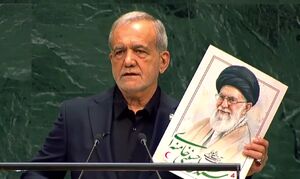
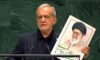
According to Choghadak News: Hossein Sarmashghi, one of the international law researchers and media activists of Bushehr Province, in a note addressed various dimensions of Masoud Pezeshkian’s authoritative and prideful speech at the UN in defense of the sacred system of the Islamic Republic and wrote: From the perspective of international law, Donald Trump’s speech at the UN General Assembly was not only a political statement; rather, it was a set of explicit violations of international obligations. On the other hand, Masoud Pezeshkian’s speech, which was delivered in compliance with international standards, also showed the Islamic Republic’s mastery of international etiquette and rules and its respect for them. Both require precise legal analysis, part of which we address here.
The first and most important violation was the explicit threat to use force against the Islamic Republic of Iran, when Trump claimed in his speech: “Either we make a deal… or we will destroy the Islamic Republic of Iran.” This statement is a direct violation of Article 2(4) of the UN Charter, which explicitly prohibits any threat or use of force against the territorial integrity or political independence of any state. Iran’s permanent representative to the UN also, in an official letter to the Security Council, called these threats a clear and serious violation of the aims and principles of the UN Charter and demanded their decisive condemnation.
The second legal violation was the attack on the independence of the International Criminal Court, when Trump, by asking member states to withdraw from this body and describing it as an anti-American court and a rogue institution, effectively targeted international judicial independence. This is while the United States and Israel are themselves not members of this court, but they try to invalidate its jurisdiction for other countries. The main motive for this opposition has been the issuance of an arrest warrant for Benjamin Netanyahu and Yoav Gallant on charges of war crimes and crimes against humanity in Gaza.
The third legal issue was the clear contradiction in Trump’s position: on the one hand, he threatened Iran with destruction, and on the other hand, he claimed readiness for an agreement. This dual approach is completely in conflict with the principle of good faith in international negotiations, which is rooted in the law of treaties and the practice of the International Court of Justice, and is contrary to law. A military threat simultaneous with an offer of negotiation is not diplomacy; rather, it is a form of coercion that also lacks legitimacy in international law.
The fourth contradiction was Trump’s contradictory position regarding the United States’ obligations: he presents himself as a defender of the international order, yet in the same speech he withdrew from climate agreements and UNESCO, and has barred America from paying its share to the UN. This behavior is also a violation of the principle of international cooperation enshrined in Article 1(3) of the UN Charter.
Pezeshkian’s Legal and Moral Superiority / Observing the Legal Framework versus Violating the Law
In contrast to Trump’s threat-centered discourse, Masoud Pezeshkian, the President of the Islamic Republic of Iran, based his speech precisely on the standards of international law, and what makes this speech a model of legal diplomacy on the international stage is its precise observance of the boundary between legitimate self-defense and aggression. Pezeshkian at the beginning of his remarks, with the short and striking sentence “We are not terrorists; we are victims of terrorism,” answered Trump’s accusation not by repeating reciprocal claims, but by relying on legal facts. By referring to the assassination of the martyred leader of the Islamic Republic of Iran, which was carried out without any legal reason and without any proof, and also to the bombing of schools, hospitals, universities, and civilian infrastructure with American and Israeli weapons, he cited them as objective instances of war crimes and violations of international humanitarian law.
The key point in the remarks of Masoud Pezeshkian, the President of the Islamic Republic of Iran, was the emphasis on legitimate self-defense as the inherent right of every state. In this regard, he stated: “We only defend ourselves… We have never started any war… but we do not fear war to defend ourselves, and we do not avoid negotiation for peace.” This position is exactly consistent with Article 51 of the UN Charter, which recognizes the right of legitimate self-defense against armed attack.
The assassination of Ismail Haniyeh in Tehran was another clear example of a violation of international law, which Pezeshkian referred to, and the Ministry of Foreign Affairs of Iran considered this act a great crime and a gross violation of the principles and norms of international law, national sovereignty, and territorial integrity. From a legal perspective, this assassination is equivalent to extrajudicial killing and a violation of the right to life as a jus cogens rule of international law.
Pezeshkian also, by exposing the double standards of the global power structure, raised one of the deepest legal challenges of the international system for the first time at this General Assembly and said: “Nuclear weapons are in Israel while inspectors are in Iran; Israel kills, but Iran is sanctioned.” This contradiction challenges the foundation of the principle of sovereign equality of states enshrined in Article 2(1) of the UN Charter.
Respect for diplomatic rules was also one of the prominent features of Pezeshkian’s remarks. Despite Trump’s insults, he avoided any reciprocal destruction or insult and spoke within a fully legal and diplomatic framework, declaring Iran’s readiness for negotiation conditional on the lifting of sanctions and respect for the rights of the Iranian nation. Undoubtedly, this position is fully consistent with the principle of peaceful settlement of disputes in paragraphs 1 and 2 of Article 33 of the UN Charter.
Pezeshkian’s Speech Was a Multi-Layered Diplomatic Operation
Pezeshkian’s speech at the UN General Assembly can be considered a multi-layered diplomatic operation that acted on three distinct levels, which can easily be interpreted.
First level: Direct legal response to accusations. Pezeshkian, by citing objective instances—from the assassination of the Supreme Leader of the Revolution to the bombing of schools and sports halls and the assassination of Ismail Haniyeh in Tehran—returned the accusation of terrorism to its actual perpetrators and said: “Those who are terrorists and train terrorists tell us that you are terrorists.”
Second level: Display of international legitimacy. Pezeshkian, by noting that Iran has not attacked any country for 200 years, raised the flag of peace-seeking, while emphasizing that we have the necessary power, because a nation that cannot defend itself will be crushed. This position is exactly the same legal balance between the right of legitimate self-defense and the principle of non-aggression.
Third level: National unity and internal cohesion. Pezeshkian’s reference to the people’s round-the-clock and 200-day presence in the streets over the past seven months to defend the country not only reflected a social reality, the people’s commitment, attachment, love, and adherence to the Islamic Republic, but also conveyed the message of national unity to the world and said: “The people are our power, and we stand with authority through the power of the people.” The support of various political figures and broad media reflection in response to these remarks showed that Pezeshkian’s words greatly helped strengthen national unity and made people more emotional, more sympathetic, and more loyal than before.
The international effects of the President’s speech were also very significant, and the broad reflection of the speech of the head of the Islamic Republic’s diplomatic apparatus in world media and numerous analyses of its content showed that Iran’s narrative of resistance and peace-seeking has become a clear, coherent, and effective discourse at the global level. In this speech, Pezeshkian displayed an image of a powerful and dignified Iran in the light of public diplomacy that was approved by all different political strata.
Media and Public Opinion Reaction to Trump’s Global Scandal
In contrast to the widespread welcome of Pezeshkian’s remarks, Trump’s speech at the UN General Assembly faced critical and even mocking reactions at the international level and even from American media. American media criticized this speech from various angles. In this regard, the Wall Street Journal pointed to Trump’s contradiction in using the midterm elections as a tool of pressure while ignoring its political consequences. On the other hand, the New York Times described these remarks as a warning bell for America’s withdrawal from the international order, and the Washington Post highlighted and criticized his harsh and aggressive language.
Analyses indicate that Trump’s 57-minute speech, which was longer than the allotted time, was met with nervous laughter and indifference from those present. One analytical note in the New York Post described this speech as insulting and a great scandal for Americans and expressed surprise at why representatives of countries did not leave the hall. More interestingly, CNN was the only network that boycotted the live broadcast of Trump’s speech.
These reactions indicate America’s growing isolation in the new international order. A Pew poll that had previously shown that only 23 percent of people in 36 countries were confident in US leadership during the Trump era now shows that public opinion has changed and indicates an unprecedented decline in global trust in Washington and Trump.
In this speech, Trump criticized the UN 11 times and questioned the necessity of multilateral cooperation 6 times. This was while after his speech at the UN—which everyone considers subservient to Washington’s decisions—in a meeting with the UN Secretary-General, he noticeably moderated his tone and claimed that he definitely supports the UN. This behavioral contradiction further weakened the credibility of America’s discourse on the international scene.
The Battle of Truth and Falsehood in the Legal and Moral Arena
The confrontation between Pezeshkian and Trump at the 80th UN General Assembly was beyond a political confrontation and should be interpreted as a battle of truth and falsehood in the legal and moral arena at the international level.
By threatening to destroy Iran, attacking the independence of the International Criminal Court, questioning multilateralism, and misusing the UN podium for election propaganda, Trump effectively challenged the legal legitimacy of the international system. But this approach not only brought no achievement for Washington; it also contributed significantly to America’s further isolation and reduced global credibility.
In contrast, Pezeshkian, by precisely observing legal frameworks, citing the principles of the UN Charter, avoiding the language of force and insults, and observing courtesy and respect, consolidated the legal and moral legitimacy of the Islamic Republic of Iran on the world stage. In fact, it must be said: his speech was not only an attack; rather, it was a precise and multi-layered diplomatic operation at four levels: legal, political, media, and public opinion. It was able to strengthen national unity domestically among all different political and popular groups and make Iran’s authority on the international stage more visible than before.
Finally, we must state that what makes this confrontation meaningful for the new world order is the legal fact that in the twenty-first century, military power alone does not guarantee security, and a world that understands only the language of force, as Pezeshkian warned, will be the beginning of a more dangerous world for all of us. Iran, by raising the image of the martyred leader and the martyrs of the third imposed war, and by relying on the soft power of dignified diplomacy, proved that international legitimacy is the main capital for survival and progress in the new world order./End of message
false
true


false
true